
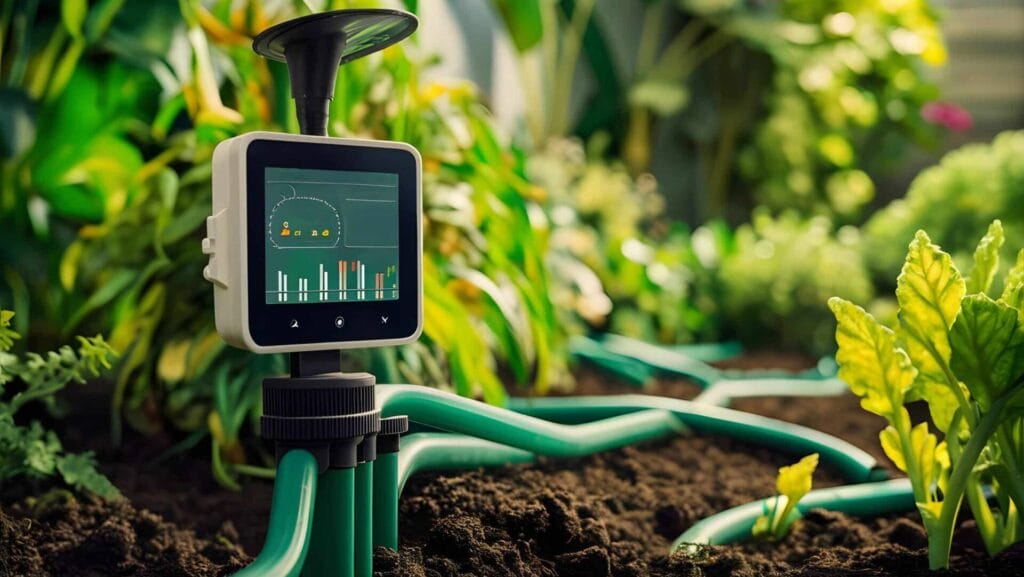
Most Austin lawns are watered too often and too briefly. That combination trains roots to stay near the surface, where they cook in July. The fix is not more water, it is differently delivered water.

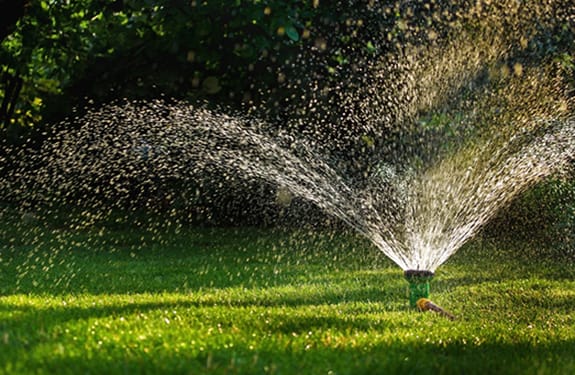
The number and what it means
Roughly an inch a week is the working figure for established warm-season grass in Central Texas, including whatever rain falls. In peak summer it may be more, in spring and fall considerably less.
Rather hand it off? See our Austin lawn care: mowing, feeding and weed control on a schedule that fits Austin's watering rules.
The important part is delivery. One or two deep sessions beat daily light watering every time, because deep water pushes roots down where soil stays cooler and holds moisture longer. Fifteen minutes every evening produces a lawn that cannot survive a week without you.
Measure what your system puts down
Nobody knows their sprinkler output without measuring it, and the guesses are usually wrong by half. Put several straight-sided containers around a zone, tuna cans work, and run it for fifteen minutes. Measure the depth in each.
That tells you two things: how long you need to run to deliver an inch, and whether your coverage is even. Wildly different depths between cans means a coverage problem no run time will fix. That is an irrigation design issue, not a scheduling one.
Work inside the rules
Austin restricts automatic irrigation to assigned days by address and prohibits midday watering. Surrounding cities run their own schedules. That constraint is actually compatible with deep infrequent watering, which is fortunate.
On clay, split each session into shorter cycles with soak time between so water absorbs instead of running to the street. Texas A&M runs WaterMyYard, a free service publishing weekly watering recommendations for Central Texas based on local weather data. It is almost always less than a default controller schedule assumes.
New plantings play by different rules
Everything above assumes established grass and plants. New sod, new plugs and newly planted shrubs need frequent shallow watering at first, which is the opposite advice, because their roots have not reached down yet.
New sod typically needs daily watering for the first couple of weeks, then tapering over the following month toward the deep and infrequent pattern. The tapering is the step people skip: they either stop abruptly and lose the sod, or keep daily watering forever and produce a lawn that never roots deeply.
Native and drought-tolerant plants are not drought-tolerant on day one either. They need regular water through their first full summer before they can be left alone.
Signs you are getting it wrong in either direction
Too little: footprints stay visible after you walk across the lawn, blades fold along the midrib, and color shifts toward blue-grey before it browns. That folding is an early signal worth learning, because it appears before visible damage.
Too much: spongy ground underfoot, mushrooms appearing, moss in shaded areas, and yellowing that looks like hunger but is actually roots without oxygen. Persistent wet areas also invite the fungal problems that show up as brown patch in cool weather.
If parts of the yard show one set of symptoms and other parts the opposite, the problem is coverage rather than run time, and no schedule change fixes it.
Watering correctly and still losing the lawn?
Usually it is coverage or compaction rather than the schedule.