

Pulling nutsedge feels like it works for about three days. Then it comes back a few inches away, and a week later there are two of them. Learning how to get rid of nutsedge in your lawn starts with accepting that the top of the plant was never the problem — the tuber under it is.
Yellow nutsedge is not a grass, and it does not behave like a weed you can dig out between rainstorms. It spreads by underground tubers called nutlets, and each one can start a plant. Pulling breaks those connections and leaves the nutlets behind, which is how one plant becomes five.
Rather hand it off? See our Austin lawn care: mowing, feeding and weed control on a schedule that fits Austin's watering rules.
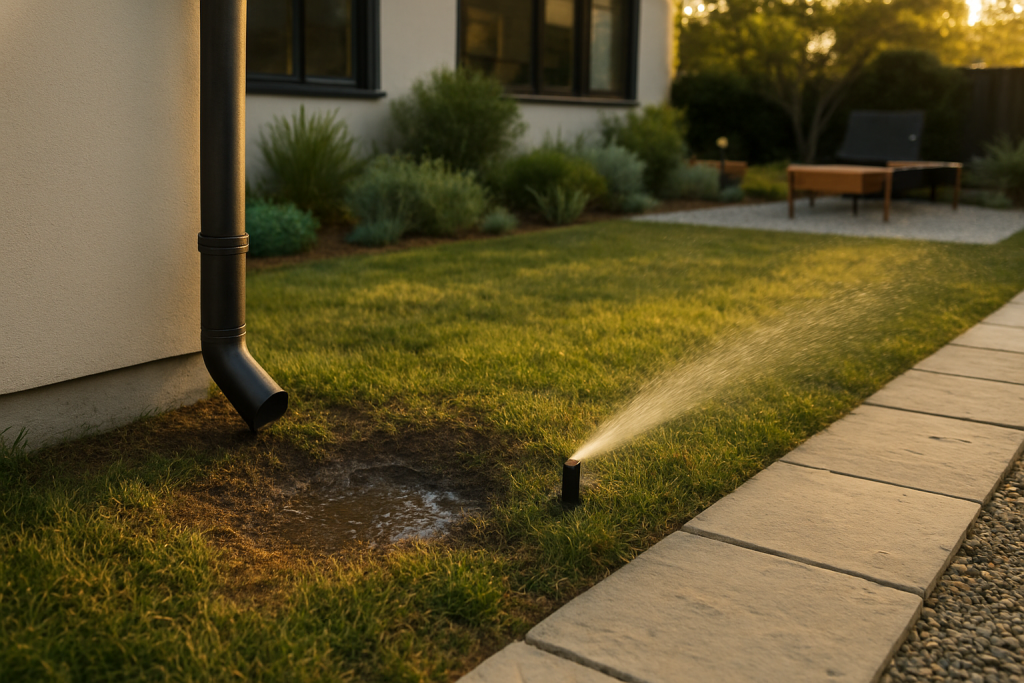
It shows up where turf is thin and soil stays wet: under an overspraying irrigation head, in the strip between lawn and sidewalk, over a shelf of clay that never drains.
Why pulling nutsedge makes it worse
The part you leave behind
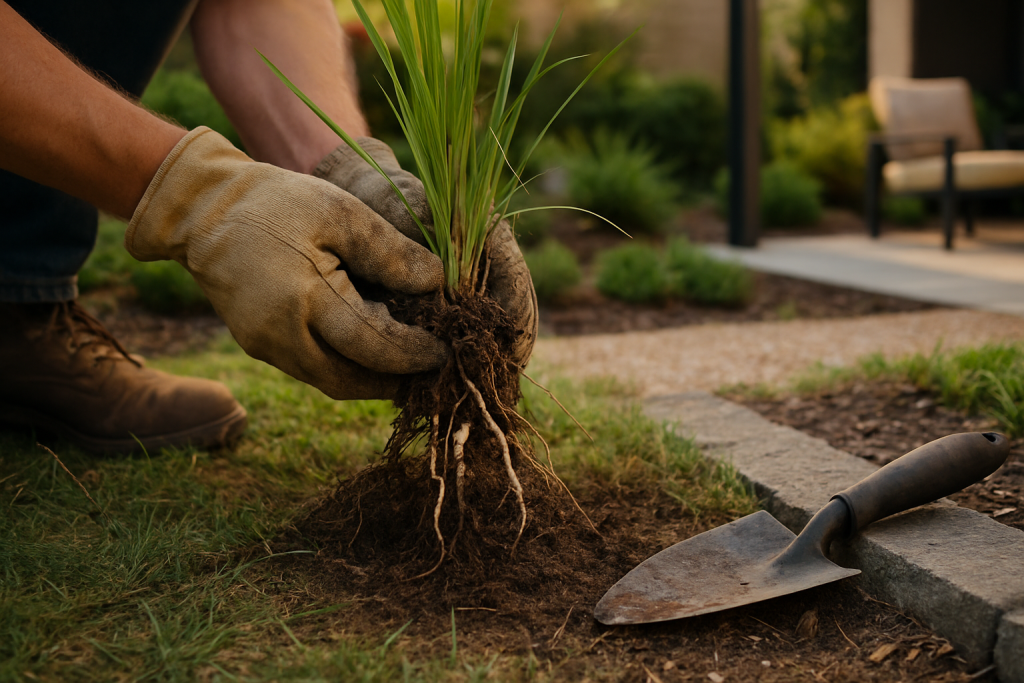
A nutsedge plant is a chain: leaves, rhizome, tuber, rhizome, next set of leaves. Pull slowly and the chain usually snaps just below the crown. You get the leaves; the tuber stays where it was, with its stored energy intact, and pushes a new shoot within days.
Digging is not much better. Every cut rhizome is a chance to start again, and the basal bulb sits just deep enough that a hand cannot reliably reach it.
The one case where pulling works is a seedling that came up this spring and has not made tubers yet. If it resists at all, it has already stored something.
How to tell nutsedge from crabgrass
Both appear in thin, wet turf in late spring, and both get called “the weed” in the same sentence. They are different plants with different weaknesses.
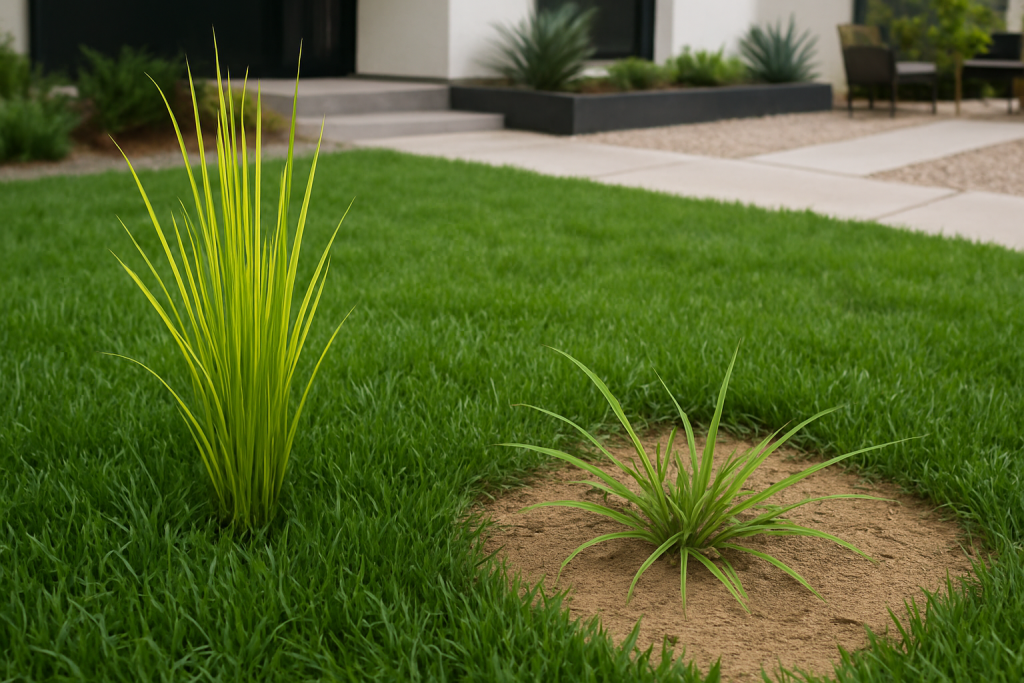
Crabgrass is flat and sprawling: wide blades, roots at the nodes, spreads by seed, dies at the first hard frost. Most crabgrass products are built to kill it.
Nutsedge is upright and fast. Two weeks after a mow it is often the tallest thing in the lawn, lighter yellow-green, coming up in clumps rather than a mat. Frost browns the leaves; the tubers wait.
The stem test
Hold the stem between thumb and forefinger and try to roll it. Grass stems roll. A sedge stem has three flat sides, so it resists. Leaves in threes from the base and a brownish-gold seed head confirm it. The old field rhyme — sedges have edges — settles it, and it is the difference between a crabgrass product that does nothing and a sedge-labeled one that works.
Why it grows there in the first place
Nutsedge is a wet-soil plant that tolerates dry once it is established. In Central Texas it turns up on clay that holds water, in the low corner where the grade flattens, at the end of a downspout, and in the one square foot an irrigation head hits every morning. It needs light, so it takes thin turf.
What that means for treatment
Spray and leave the wet spot, and expect another flush from tubers already in the soil. Regrading a low corner, extending a downspout or changing a nozzle is slower and less satisfying than a sprayer, but it is the half of the job that keeps the patch from coming back. See drainage and grading — we will tell you whether it is a drainage problem or a thin patch.
When to treat, and what kills the nutlet
Timing
A selective herbicide has to move down into the tuber, and it only moves while the plant is growing. Spray a heat-stressed plant, or one that has already flowered, and you burn leaves and leave the tuber. The window here is mid-spring into early summer, while plants are young. Leave a few days between mowing and spraying so enough leaf surface is there to take up the product.
What actually kills it
Two active ingredients do most of the turf work: halosulfuron and bentazon. Halosulfuron is the one usually reached for on yellow nutsedge in home lawns; bentazon is the older option and generally stronger on purple nutsedge. Expect at least two applications, spaced per the label — the first pass misses tubers that had not yet sent up a shoot.
The label is the only document that matters for rate, surfactant, temperature limits and how soon you can overseed. Halosulfuron has soil residual, so check the interval before seeding. On St. Augustine and centipede, an over-application sets turf back further than the nutsedge did.
Pre-emergents labeled for nutsedge work on sprouting tubers, not on plants already up. That is next spring’s plan.
After spraying, leave the yellowing plants alone for two to three weeks. The product is still moving down, and pulling early takes the delivery system with it.
Fill the bare spot
A dead nutsedge plant leaves a hole in the canopy, and bare soil is where the next one starts. For warm-season lawns — St. Augustine, Bermuda, zoysia — grass closes a gap fastest from late spring into summer. St. Augustine spreads by runners, so it is sodded or plugged, not seeded.
FAQ
Can I do this myself?
Small patches in Bermuda or zoysia are a reasonable DIY job with a labeled sedge herbicide and a surfactant. St. Augustine and centipede are less forgiving of a mis-measured rate. If the patch has already come back twice, the product is not the missing piece — the site is.
When is the best time to treat it?
Mid-spring to early summer, while plants are young and growing. Late-summer treatments still work, but by then the plant has put energy into new tubers, so budget for more follow-up.
What does it cost?
Any number quoted without seeing the property is a guess. Three things drive it: how much area is affected, how many applications it takes, and whether grading or an irrigation adjustment is part of the fix. We look at the property first and tell you which of those you actually need.
Nutsedge back a few weeks after you pulled it? Usually the tuber, and often a wet spot feeding it. We will tell you which. Get your free estimate at innovationgrounds.com.