
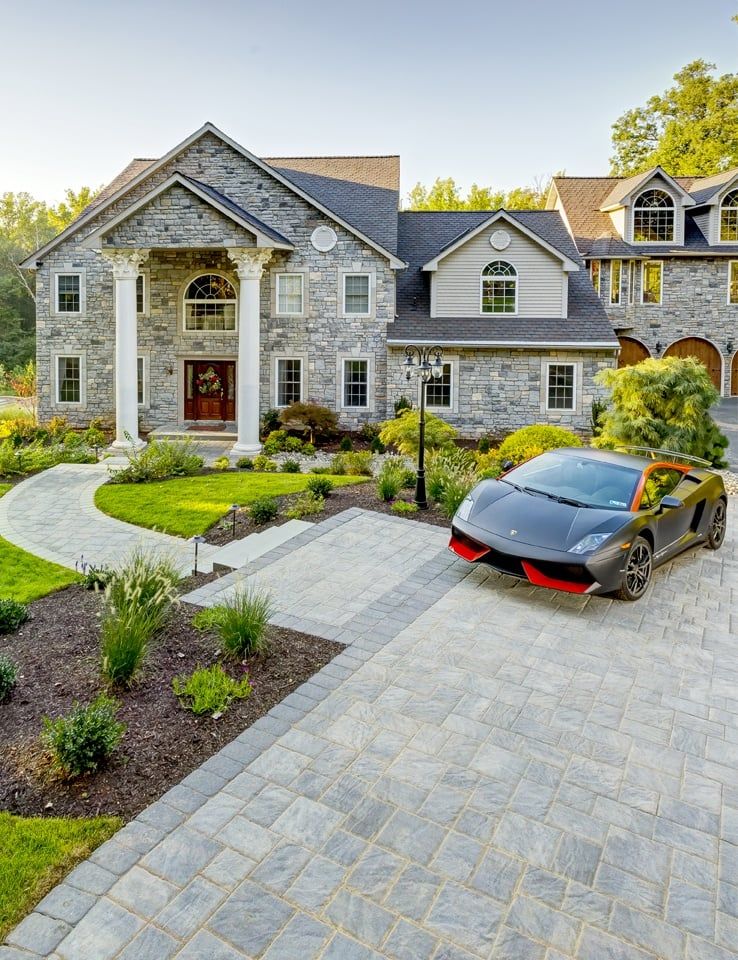
Both work. They fail differently, cost differently and feel different underfoot in August, and on Central Texas soil one of those differences matters more than people expect.
How each behaves on our soil
Blackland clay moves. It swells when wet and shrinks when dry, and anything rigid on top of it eventually cracks. Concrete will crack; control joints determine whether it cracks where you planned or somewhere you did not.
Pavers are individually set, so they flex with the ground rather than fighting it. When settling occurs, you lift the affected area, correct the base and reset. That repairability is the strongest argument for pavers in this region.
Heat underfoot
Large expanses of concrete store and radiate heat. A wide light concrete patio in an Austin summer is uncomfortable barefoot and warms the adjacent house.
Pavers are not automatically cooler, but color choice matters more with them and joints break up the mass. Either way, shade does more than material: a pergola or a tree over the space changes the experience more than the surface choice.
Cost and installation
Concrete is usually cheaper up front for a simple rectangle. Pavers cost more in labor because each unit is set, and the base preparation is more demanding.
Over a longer horizon the gap narrows. Cracked concrete is difficult to repair invisibly and often gets replaced; pavers get reset. If you plan to be in the house a long time, factor that in.
Choosing between them
Pavers suit expansive clay, irregular shapes, areas where you may want to modify later, and anywhere appearance is a priority. Concrete suits large simple areas, tight budgets, and situations where a smooth continuous surface is needed.
Whichever you choose, the base is what determines longevity, and drainage away from the house matters more than either. See concrete work and hardscaping for how we build each.
Base preparation for each
A concrete patio needs a compacted sub-base and, on expansive clay, reinforcement and correctly placed control joints. Those joints do not prevent cracking; they decide where the crack happens, which is the difference between a straight line at a planned interval and a random fracture across the middle.
A paver patio needs a deeper and more carefully compacted aggregate base, a levelling layer, and edge restraint around the whole perimeter. Without restraint the outer courses migrate and the field opens up within a few seasons.
On clay, geotextile fabric between soil and base stops the two mixing over years of wet and dry cycles. That mixing is what produces the gradual settling people notice five years in and blame on poor workmanship, when it is usually a missing fabric layer.
Repair and modification
This is where pavers earn their price difference. A settled area is lifted, the base corrected, and the same units reset. A stained or damaged unit is swapped individually. Running a utility line under a paver patio means lifting a strip and putting it back.
Concrete offers none of that. A crack is repaired visibly or lived with, and running anything underneath means cutting and patching. Colour-matching a concrete repair to weathered concrete is close to impossible.
If there is any chance of future changes, an extension, a pool, an outdoor kitchen with utilities, pavers keep those options open at a much lower cost than they will be through a slab.
Comfort, glare and maintenance
Light-coloured surfaces stay cooler underfoot, which matters enormously around a pool or anywhere people go barefoot in summer. They also produce more glare in direct afternoon sun, so very light smooth finishes can be uncomfortable to look at.
Concrete needs sealing periodically if you want to resist staining, and a large slab shows every stain. Pavers hide localized staining better simply because the pattern breaks up the surface.
Paver joints need sand topping up occasionally and weeds appear in them. Polymeric sand reduces both considerably. Neither surface is maintenance free, but the paver maintenance is small and ongoing while the concrete maintenance is rare and, when it arrives, large.
Common questions we get about this
Three come up almost every time.
Can I do this myself? Usually part of it. The diagnostic work and the finishing details are where experience shows, and the preparation underneath is where shortcuts cost the most. Most homeowners who do it themselves succeed on the visible work and struggle with base preparation, drainage and timing.
When is the best time? In Central Texas, almost always autumn. Soil is still warm, air has cooled, and anything planted or installed has months to settle before summer stress arrives. Spring works but races the heat.
What does it cost? Any number quoted without seeing the property is a guess, because our two soils, the slope and the access change the work substantially within a few miles. What we can say is that the invisible preparation is where the real cost sits, and where the cheapest bid has usually economized.