
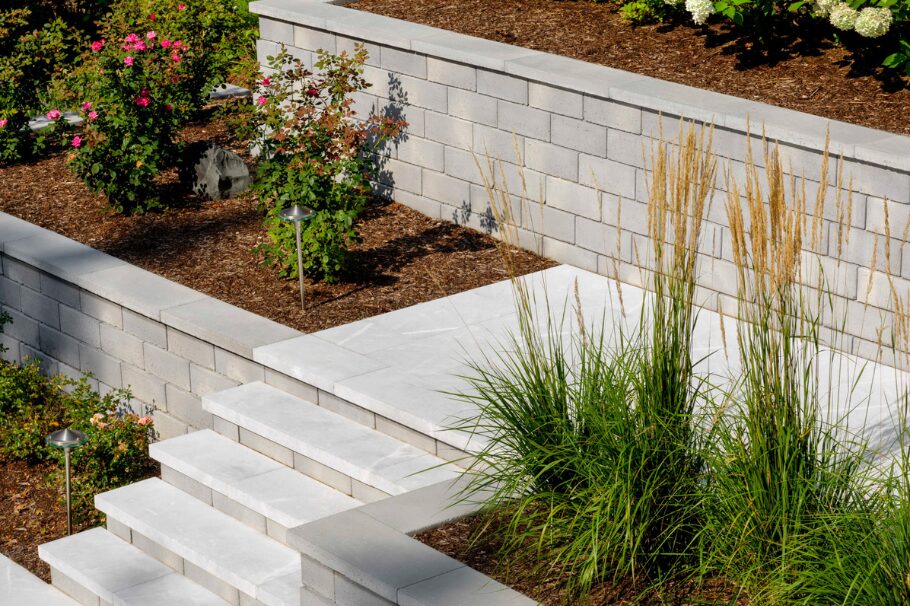
Everyone chooses a retaining wall by how the face looks. What determines whether it is still standing in ten years is entirely behind it.

Drainage decides everything
Walls fail from water pressure, not weight. Saturated soil behind a wall with nowhere to drain pushes it over, and on blackland clay that pressure is considerable.
Proper construction means gravel backfill, filter fabric between gravel and soil, and a perforated drain line with an outlet. All of it is invisible when finished, which is exactly why it is what cheap bids omit. Ask any bidder to describe the drainage detail.
Limestone and boulders
Native limestone belongs here visually and is widely available. Dry-stacked stone walls suit lower heights and let water pass through, which reduces the pressure problem. Boulder walls handle larger grade changes and look natural on Hill Country lots.
Both are labor-intensive and therefore not cheap. They age extremely well, which is the argument for them.
Segmental block
Manufactured block is the workhorse: engineered, consistent, faster to install and available with geogrid reinforcement for taller walls. It costs less than stone and performs predictably.
The tradeoff is appearance. Block reads as manufactured, though better products have improved considerably. In a naturalistic Hill Country setting stone usually looks right; in a newer subdivision block often looks appropriate.
Timber, and what to avoid
Timber is the cheapest and the shortest-lived. In Texas heat and with our wet-dry soil cycle, expect a decade or so before replacement. It can make sense for low garden beds; it rarely makes sense for a structural wall.
Height is where projects need professional attention. Above certain heights walls typically require engineering and permitting, and thresholds vary by jurisdiction. Two terraced lower walls are often safer, cheaper and better-looking than one tall wall. See hardscaping and drainage for how the two connect.
Height, engineering and permits
Most jurisdictions set a height above which a retaining wall requires engineering and a permit, and the threshold varies locally. Building above it without permits creates a problem at resale as well as a safety risk.
Taller walls also need geogrid reinforcement extending back into the retained soil, which means excavating far behind the wall face. That requirement surprises people, because the visible wall is a small part of the excavation.
Terracing two shorter walls with a planted bench between them often avoids the threshold entirely, costs less, drains better and looks considerably better than one tall wall. On most residential slopes it is the better answer even where a tall wall would be permitted.
The base and the backfill
A wall sits on a compacted gravel base below grade, and the first course being level and properly buried is what determines whether the whole wall is straight in ten years.
Behind the wall goes free-draining gravel, separated from the retained soil by filter fabric so fines do not migrate in and clog it. A perforated drain line at the base carries water to an outlet.
On blackland clay this matters more than almost anywhere, because saturated clay generates enormous pressure and the clay itself will not let water pass. A wall built directly against clay with no drainage layer is a wall with a limited lifespan, regardless of what the face is made of.
Matching the wall to the setting
Native limestone suits Hill Country properties and West Austin lots, where it reads as part of the landscape rather than an addition to it. Dry-stacked stone also allows water through, which reduces the pressure problem at lower heights.
Segmental block suits newer subdivisions and larger grade changes, where engineering and consistency matter more than character. Better block products have improved considerably in appearance.
Boulder walls work on rural and larger lots where scale suits them and where machinery can access. On a small suburban yard they overwhelm the space. The right answer is usually the one that matches what the rest of the property is already built from.
Common questions we get about this
Three come up almost every time.
Can I do this myself? Usually part of it. The diagnostic work and the finishing details are where experience shows, and the preparation underneath is where shortcuts cost the most. Most homeowners who do it themselves succeed on the visible work and struggle with base preparation, drainage and timing.
When is the best time? In Central Texas, almost always autumn. Soil is still warm, air has cooled, and anything planted or installed has months to settle before summer stress arrives. Spring works but races the heat.
What does it cost? Any number quoted without seeing the property is a guess, because our two soils, the slope and the access change the work substantially within a few miles. What we can say is that the invisible preparation is where the real cost sits, and where the cheapest bid has usually economized.