

If you ask how much does lawn mowing cost in Austin, you will get three different numbers for the same yard, and none of them is automatically wrong. Mowing is priced on how long the visit takes and what the crew has to work around, not on a citywide rate. The honest part: any number quoted before someone walks the property is a guess, ours included.
What you can do before a single bid arrives is learn what moves the number. Four things do most of the work — lot size, gate width, slope and frequency — and you can measure all four yourself this afternoon. Once you know them, a bid stops looking like a mystery price and starts reading like a description of your yard.
Rather hand it off? See our Austin lawn care: mowing, feeding and weed control on a schedule that fits Austin's watering rules.
Here is how each one changes the quote, and what to ask so the bid you sign matches the yard you own.
Lot size means turf, not lot lines
The square footage that matters is the grass that actually gets cut, not the acreage on your survey. A quarter-acre lot with a wide driveway, a pool and deep beds can hold less turf than a smaller lot with an open back. That is why two neighbors on the same street can be quoted differently.
Pace out the turf and write it down, then count the things that slow a crew down: bed edges, fence lines, walkways, trees, planters, a playset. Every tree is string-trim time. In our experience an open rectangle of grass mows faster than a smaller yard chopped up by beds and shade.
Measure the grass, not the property
Take the turf area in square feet and the rough linear feet of edge you want trimmed or cut against. Those two numbers explain most of the difference between bids.
Gate width decides which machine shows up
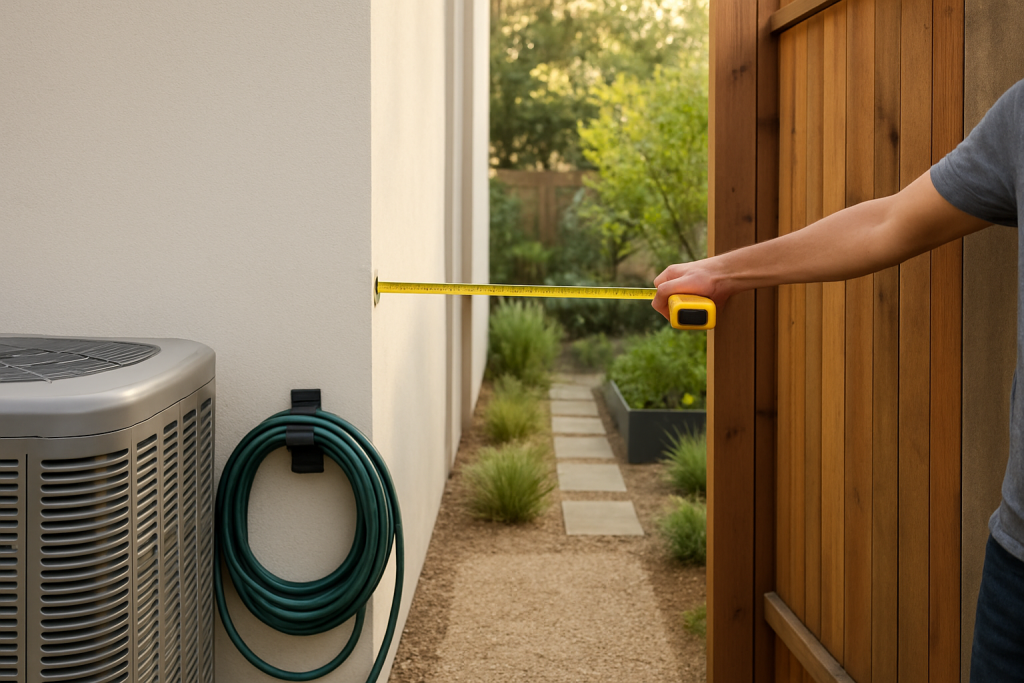
A crew cannot mow a backyard it cannot reach. Walk your side gate and measure the narrowest point along the whole path — not just the opening, but the gap between the house and the fence, the hose reel, the AC unit. A standard gate lets a full-size mower through; a narrow one means a smaller deck, and a smaller deck means more passes over the same grass.

If there is no side access, ask what happens. Some crews carry equipment through the garage, some mow only the front, some decline the job. Better to hear that before the first visit than after it.
Slope changes the time and the equipment
A slope you can walk up comfortably is a different job on a mower. A gentle grade gets cut slowly; a steep one may need a walk-behind unit or string trimming instead, because a heavy mower on a wet Austin clay bank will slide, rut the turf and tear the edge. Safety is part of the price whether or not the bid says so.
Point at your worst slope and ask how they plan to cut it. A crew that has an answer has done this before.
Frequency sets the real per-visit number
A weekly visit and an every-other-week visit are not the same job at different intervals. Weekly, the mower takes a little off the top, the yard stays at a manageable height and the visit is quick. Skip a week in the growing season and that visit takes longer, often with bagging, because you cannot leave heavy clippings on warm-season grass.
One-time cuts are priced higher per visit for the same reason: no route to fold you into, and usually tall grass to bring back down. When you compare bids, compare them at the same frequency, or you are comparing two different jobs.
Planning a season of mowing for your own yard? Our team does lawn care and maintenance around Austin and walks the property before quoting.
How to read a bid line by line
What the number should include
A per-visit price should say what it covers: mowing height, edging, trimming around obstacles, blowing clippings off walks and drives, and whether clippings are mulched back in or hauled away. If the bid is monthly, ask how many visits that buys and what happens in a five-week month.
What to ask before you sign
Ask whether they walked the property or priced it from photos, what costs extra (bagging, leaf cleanup, storm debris, hauling), and whether they carry insurance. Then ask the question most homeowners forget: what happens to the price if you change frequency, or if the gate they assumed is not the gate you have.
None of that replaces the walk. A bid is only as good as the assumptions behind it, and the assumptions live in your side yard.
FAQ

Why is my neighbor’s quote lower than mine?
Usually the yard, not the company. Turf area, the number of trees and bed edges, gate width, slope and frequency all move the number, and a neighbor’s open back may simply take less time than yours. Compare the two bids line by line before you assume you are being overcharged.
Is weekly mowing cheaper than every other week?
Per visit, usually yes, because weekly cutting removes less growth and takes less time. Per month, it is more visits. In the Central Texas growing season, every other week often turns into longer visits with bagging, which is why the two schedules are not directly comparable.
Can I get a firm price from photos?
Photos help a company prepare, and they are no substitute for the walk. A photo rarely shows the gate latch, the slope behind the shed or the tree roots at the curb. Expect a range from photos and a firm number after someone stands in the yard.
Get your free estimate from Innovation Grounds — we walk the property before we quote, so the number you get is about your yard. Book an estimate