
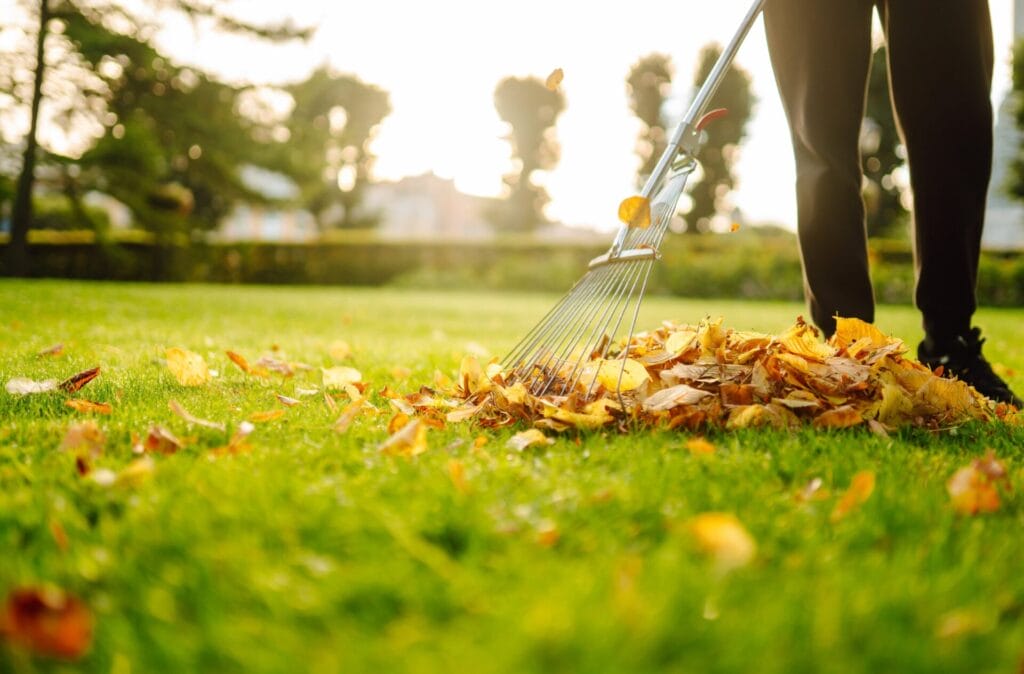
Every fall the same question: rake and bag, or leave them. The honest answer depends on how many leaves you have and what is underneath them, and getting it wrong either wastes free material or suffocates the lawn.
Mulch them into the lawn, if the layer is thin
A light scattering of leaves can simply be mowed over. Shredded leaf litter breaks down within weeks, returns organic matter to the soil, and on our alkaline ground that is genuinely useful. Run the mower over them a couple of times until the pieces are small enough that you can still see grass through them.
Planning something like this for your own yard? Our team does landscape design and installation in Austin, from the first sketch to the last plant.
The limit is coverage. If after mowing you cannot see the lawn, there is too much material and it will mat down, block light and hold moisture against the crowns. That is how you get fungal problems in a mild wet winter.
Compost the surplus rather than binning it
Excess leaves are the best free carbon source you will find all year. Piled with some green material and turned occasionally, they become the compost you would otherwise buy by the yard in spring.
Oak leaves break down slowly, which is fine but not fast. Shredding them first, again with the mower, cuts the timeline considerably. Keep the pile moist but not soaked, and expect usable material by late spring.
Where leaves must come off entirely
Off the lawn once the layer is thick, off gutters before the first real storm, off drains and swales where they will block flow, and out of the crowns of low plantings where they trap moisture.
They can stay in beds and under trees, which is where they fall naturally and where they suppress weeds and feed soil. A bed mulched with its own leaves is doing exactly what it should. That is also the moment to check drainage before winter rain arrives.
Timing it with the rest of the fall work
Leaf drop here runs late, often well into December, so a single cleanup rarely covers it. Two or three passes beat one heroic effort, and the lawn stays uncovered through the period when it is still photosynthesizing.
Fold it in with the other fall jobs: the last feeding of the year, refreshing mulch in beds, and any oak work now that the safe pruning window has opened. See our tree care page for why that timing matters.
What we do
Seasonal cleanups, leaf removal, and mulching where the material is worth keeping on site. On larger lots we usually recommend mulching most of it and hauling only the surplus, because carting away free soil amendment and then buying compost in March is a strange round trip.
How much is too much on the lawn
The working test is visibility. After mowing over leaves, you should still clearly see grass blades through the shredded material. If the lawn looks brown rather than green, there is too much and the surplus needs removing.
Species matters too. Live oak leaves are small, leathery and slow to break down, so they accumulate more than you expect. Cedar elm and pecan leaves shred and disappear quickly. Large-leaved trees produce material that mats badly if left whole, so shredding is not optional with those.
Wet leaves behave completely differently from dry ones. A layer that would have been fine dry becomes a sealed mat after rain, and that is what kills grass underneath in a mild wet Central Texas winter.
Building a leaf pile that actually breaks down
Leaves alone decompose slowly because they are almost entirely carbon. Mixing in green material, grass clippings, kitchen scraps or a little manure, gives the microbes the nitrogen they need and speeds the process dramatically.
Keep the pile roughly as moist as a wrung-out sponge. In an Austin autumn that usually means adding water, since our dry spells will stall a pile completely. Turn it every few weeks if you want finished compost by spring, or leave it alone and accept a longer timeline.
Size helps: a pile roughly a cubic yard holds heat and breaks down far faster than a thin scattering. Shredding first, again with the mower, can cut the timeline in half.
Common questions we get about this
Three come up almost every time.
Can I do this myself? Usually part of it. The diagnostic work and the finishing details are where experience shows, and the preparation underneath is where shortcuts cost the most. Most homeowners who do it themselves succeed on the visible work and struggle with base preparation, drainage and timing.
When is the best time? In Central Texas, almost always autumn. Soil is still warm, air has cooled, and anything planted or installed has months to settle before summer stress arrives. Spring works but races the heat.
What does it cost? Any number quoted without seeing the property is a guess, because our two soils, the slope and the access change the work substantially within a few miles. What we can say is that the invisible preparation is where the real cost sits, and where the cheapest bid has usually economized.
Buried in leaves?
Seasonal cleanups across the Austin area, timed so the lawn is never covered for long.