
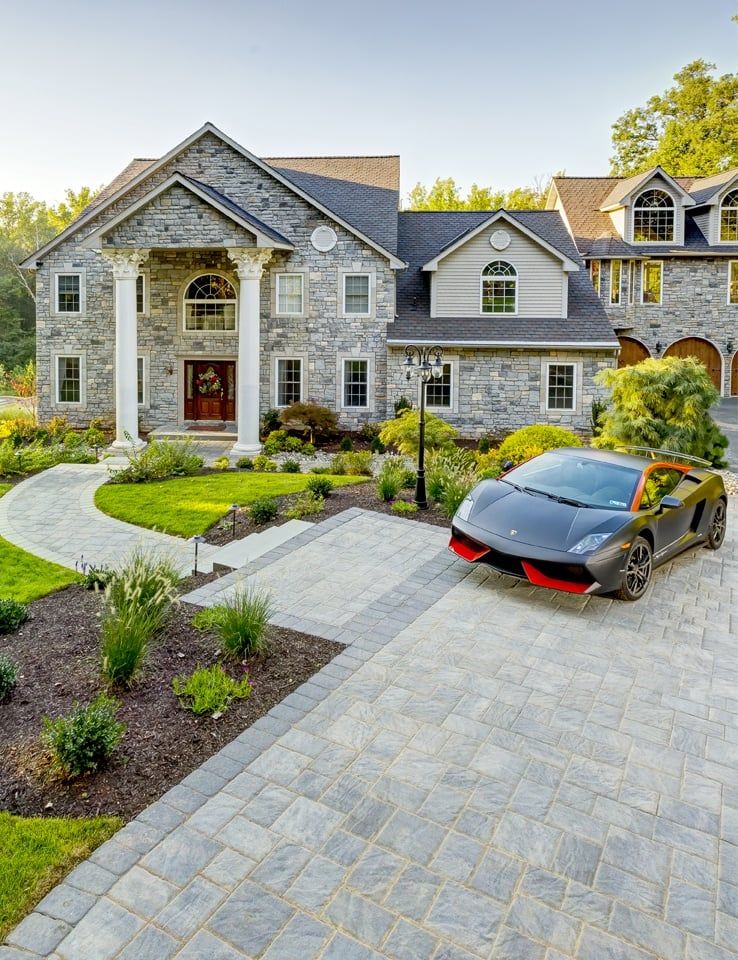
A gravel driveway costs a fraction of concrete, drains instead of shedding water, and suits rural and semi-rural lots around Austin. It also fails quickly if the base is done badly.


The base is the whole job
What fails is never the gravel you see, it is what is underneath. A proper driveway is built in layers: a compacted sub-base of larger crushed stone, then progressively finer material, each compacted before the next.
Planning something like this for your own yard? Our team does Austin landscape design, from the first sketch to the last plant.
Dumping gravel on bare clay produces ruts within a season. On blackland clay especially, the sub-base and often a geotextile fabric between soil and stone are what stop the stone slowly disappearing into the ground.
Materials that work here
Crushed limestone base with a crushed granite or limestone top is the common local build. Crushed material with sharp edges locks together; rounded river rock does not and will shift under tires forever.
Decomposed granite makes a handsome top layer but needs stabilizing for vehicle traffic. Choose by function: the base is structural, the top layer is what you look at.
Drainage and edges
A driveway should crown slightly so water sheds to the sides rather than running down the middle, which is how ruts and washouts start. On any slope, cross drains or a swale prevent the whole surface migrating downhill in a heavy storm.
Edging holds the material. Steel, stone or a soldier course of pavers all work. Without it, gravel spreads into the lawn and you top up more often than you should. See drainage solutions if your lot already sheds water across the drive.
Upkeep and when concrete makes more sense
Expect to regrade occasionally and top up every few years. Weeds need spot treatment. Snow is not a concern here but heavy rain is, and after a big storm you may need to rake material back up the slope.
Gravel stops making sense on steep grades, where washing is constant, and directly against a garage where stone tracks inside. A short concrete apron at the garage with gravel beyond is a common and sensible compromise.
Sizing and depth
A single-car drive needs roughly ten feet of width; two cars or a turning area needs considerably more. Skimping on width is the most common regret, because vehicles track onto the edges and the gravel migrates into the lawn.
Depth depends on traffic and soil. On blackland clay a typical build runs several inches of larger crushed base topped with finer material, all compacted in layers. Lighter builds work on stable ground and fail on clay.
Where trucks or trailers use the drive, or where the ground stays wet, the base goes deeper and geotextile fabric between soil and stone becomes essential rather than optional. That fabric is what stops the stone slowly sinking into the clay over several wet seasons.
Comparing the real cost against concrete
Gravel typically runs a fraction of concrete per square foot installed, which is why it is attractive on long rural drives where a concrete run would be prohibitive.
The comparison changes over time. Gravel needs regrading and topping up; concrete does not, but when concrete fails on expansive clay it cracks and the repair is rarely invisible. Over twenty years the totals converge more than the initial quotes suggest.
Where gravel clearly wins: long drives, rural lots, permeable requirements over the recharge zone, and situations where you may reconfigure later. Where concrete wins: short suburban drives, steep grades, and anywhere tracked stone into a garage would be a daily annoyance.
Maintenance you should expect
Plan on raking material back into place after heavy storms, particularly on any slope. Regrading with a box blade every few years restores the crown and fills ruts before they become permanent.
Weeds germinate in the fines. Pre-emergent in the two seasonal windows suppresses most of it, and spot treatment handles the rest. Landscape fabric under the base helps with stone migration more than with weeds, since weeds root in the material above it.
Dust is a genuine consideration on long drives in dry months. Stabilized products and dust suppressants exist, and they matter more if the drive passes close to the house or to outdoor living areas.
Common questions we get about this
Three come up almost every time.
Can I do this myself? Usually part of it. The diagnostic work and the finishing details are where experience shows, and the preparation underneath is where shortcuts cost the most. Most homeowners who do it themselves succeed on the visible work and struggle with base preparation, drainage and timing.
When is the best time? In Central Texas, almost always autumn. Soil is still warm, air has cooled, and anything planted or installed has months to settle before summer stress arrives. Spring works but races the heat.
What does it cost? Any number quoted without seeing the property is a guess, because our two soils, the slope and the access change the work substantially within a few miles. What we can say is that the invisible preparation is where the real cost sits, and where the cheapest bid has usually economized.
Thinking about a gravel drive?
The base determines whether it lasts two years or twenty.