
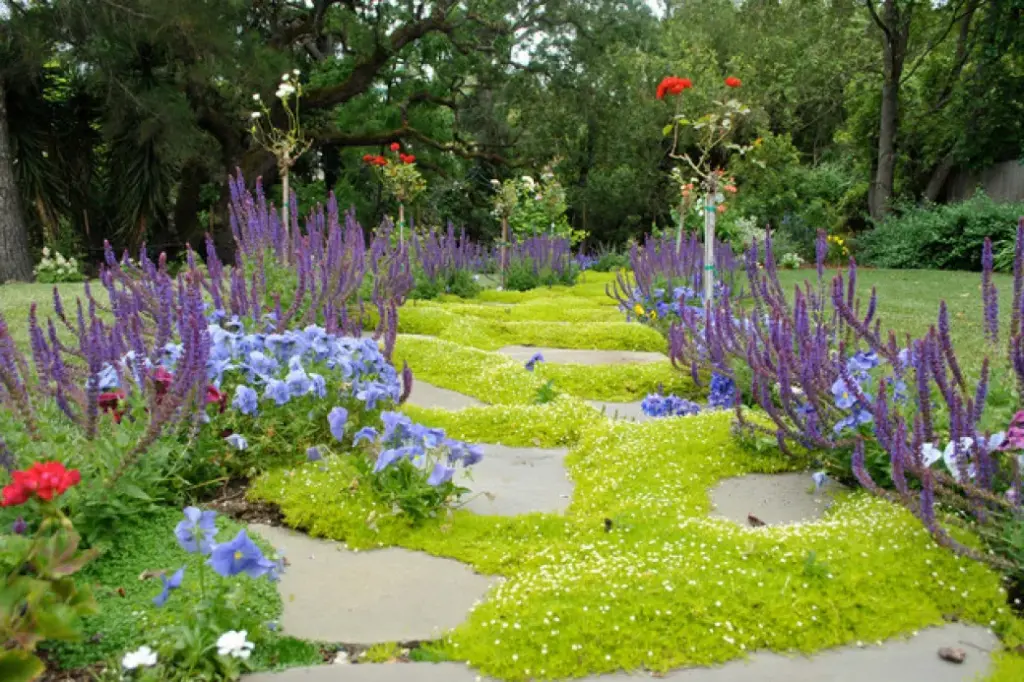
Small yards are where xeriscaping works best and where it most often goes wrong. There is no room for a mistake to hide, so structure matters more than variety.
Repeat, do not collect
The most common small-yard error is one of everything. Fifteen different plants in a compact space reads as clutter no matter how good each one is.
Choose three to five species and repeat them in groups. Autumn sage massed along a border, muhly grass repeated at intervals, a single agave as a focal point. Repetition is what makes a small space feel composed rather than crowded.
Structure first, planting second
In a small yard the hard elements carry the design. A defined path, a small seating area, a wall or a level change give the eye something to organize around. Plants fill in around that structure rather than being the structure.
Edging is not optional here. The line between bed and path is a large share of what a small yard looks like, and without it native planting reads as neglect to a neighbor and sometimes to an HOA.
Scale the plants to the space
Check mature size, not nursery size. A plant that reaches six feet across will swallow a small bed within three years, and the annual battle to keep it small ruins its shape.
Vertical space is underused in small yards. A vine on a wall or trellis, or a small multi-trunk tree like Texas persimmon or Mexican plum, adds height without taking floor area.
One good focal point beats three competing ones
Small spaces support one clear focus: a specimen agave, a water bowl, a sculptural piece of limestone, a single well-placed tree. Adding a second and a third makes the space feel busy and smaller.
Lighting extends the effect. A single uplight on that focal point does more for how the yard feels at night than a perimeter of path lights. See landscape lighting for how to do that without over-lighting.
Working with the shape you have
Most small yards are rectangles, and treating them as rectangles emphasizes how small they are. Cutting the space diagonally, with a path or a bed line running corner to corner, makes it read larger because the longest dimension becomes the one the eye follows.
Curves work in small spaces only if they are generous. A tight wiggle in a bed line looks fussy and eats usable area. One long sweeping curve, or clean straight lines, both work; the failure mode is a series of small curves that make the space feel restless.
Leaving the centre open and pushing planting to the edges also makes a small yard feel bigger, because the eye reads the open ground as the size of the space. Filling the middle with a feature does the opposite, however attractive the feature is.
Screening without closing in
Small yards usually need screening from neighbours, and the reflex is a solid fence or a dense hedge. Both work and both make the space feel smaller and hotter.
Partial screening often works better: a slatted panel, a small multi-trunk tree, or a group of tall grasses that block the sightline without blocking air or light. You only need to interrupt the view from where people actually sit, not to build a wall around the property.
Vertical planting is the small-yard specialist. A vine on a wire trellis takes almost no floor area and covers a large surface. Coral honeysuckle, crossvine and Carolina jessamine all work in Central Texas and support pollinators while they do it.
Materials and colour in a compact space
Fewer materials read as calmer. Two hardscape materials at most in a small yard, repeated, beats four different surfaces meeting each other. Matching the paving to the house stone or to the existing patio ties it together immediately.
Light-coloured surfaces make a space feel larger and stay cooler underfoot, which matters in an Austin August. Dark gravel and dark pavers absorb heat and make a small enclosed yard genuinely uncomfortable in summer.
The same restraint applies to planting colour. A limited palette repeated, mostly greens and silvers with one or two flowering accents, looks intentional. Every colour at once in a compact space reads as a nursery display rather than a garden.
Common questions we get about this
Three come up almost every time.
Can I do this myself? Usually part of it. The diagnostic work and the finishing details are where experience shows, and the preparation underneath is where shortcuts cost the most. Most homeowners who do it themselves succeed on the visible work and struggle with base preparation, drainage and timing.
When is the best time? In Central Texas, almost always autumn. Soil is still warm, air has cooled, and anything planted or installed has months to settle before summer stress arrives. Spring works but races the heat.
What does it cost? Any number quoted without seeing the property is a guess, because our two soils, the slope and the access change the work substantially within a few miles. What we can say is that the invisible preparation is where the real cost sits, and where the cheapest bid has usually economized.
Small yard, big water bill?
Compact yards convert fastest and pay back soonest.