
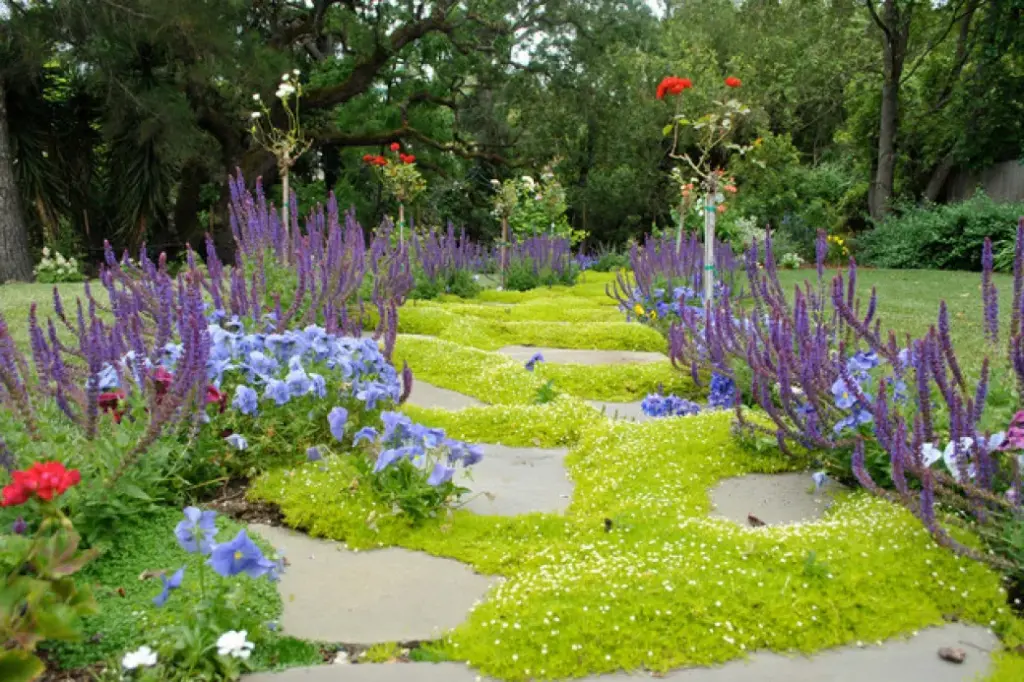
Brushy Creek homeowners often want to reduce watering and assume the HOA will not allow it. Texas law is more on your side than most people realize, but presentation matters.

What the law actually says
Under Texas Property Code section 202.007, a property owners association may not prohibit drought-resistant landscaping or water-conserving turf. They can require you to submit a plan for approval and can enforce reasonable aesthetic standards.
Planning something like this for your own yard? Our team does landscape design and installation in Austin, from the first sketch to the last plant.
So a blanket no is not enforceable. A request for a plan is. That distinction is the whole game.
Submit a drawn plan, not a request
Approvals go far more smoothly when the submission is a drawing with a plant list, defined bed shapes and materials specified. A vague request to replace grass with natives invites a no.
Show edges clearly. Most HOA resistance is really about whether the result will look intentional or neglected, and a drawn plan with clean lines answers that before anyone asks.
Design choices that read as tidy
Massing beats collecting: three to five species repeated reads as designed, fifteen singles reads as a mess. Defined steel or stone edging between bed and lawn does more for perceived tidiness than any plant choice.
Keeping a mown strip along the sidewalk and street frames the planting and signals intent. Symmetry near the entry reassures reviewers. None of this compromises water use.
Plants that satisfy both goals
Autumn sage, blackfoot daisy, damianita, muhly grasses, rock rose and Texas sage all stay compact, bloom generously and look deliberate. Avoid anything that sprawls unpredictably or dies back to bare stems for months.
Buffalo grass and Habiturf are worth mentioning specifically, since they are turf and therefore easier to approve than a full bed conversion. See our plant guide and our Brushy Creek page.
Preparing the submission
Most HOA rejections are about uncertainty rather than opposition. A committee cannot picture what you are describing, so they default to no.
A submission that gets approved usually includes: a scaled drawing showing bed shapes and hardscape, a plant list with mature sizes, material samples or photographs, and a note on how edges will be defined and maintained.
Including reference photographs of similar completed landscapes helps enormously, because it answers the question the committee is actually asking, which is whether this will look deliberate or unkempt in two years.
Common objections and how to answer them
It will look untidy. Answer with edging detail, massed rather than scattered planting, and a maintained border strip along the street.
It will not match the neighbourhood. Answer with a plant palette that includes familiar structural shapes and a design that keeps the front symmetrical near the entry.
Gravel is not permitted. Often true and often reasonable, since large gravel areas do look barren. Answer by keeping gravel to paths and drainage rather than as ground cover, and by planting densely enough that the ground is covered by plants rather than stone.
What the statute does and does not do
Texas Property Code section 202.007 prevents a POA from prohibiting drought-resistant landscaping and water-conserving turf. It does not remove their right to require plan approval or to enforce reasonable standards.
So the statute is a floor, not a blank cheque. Citing it aggressively as a first move tends to harden positions. Submitting a good plan and mentioning the statute only if refused outright usually produces a better outcome.
If you are refused with no reason given, that is the moment the statute matters. A written request for the specific basis of refusal, referencing the section, frequently resolves it without further escalation.
Common questions we get about this
Three come up almost every time.
Can I do this myself? Usually part of it. The diagnostic work and the finishing details are where experience shows, and the preparation underneath is where shortcuts cost the most. Most homeowners who do it themselves succeed on the visible work and struggle with base preparation, drainage and timing.
When is the best time? In Central Texas, almost always autumn. Soil is still warm, air has cooled, and anything planted or installed has months to settle before summer stress arrives. Spring works but races the heat.
What does it cost? Any number quoted without seeing the property is a guess, because our two soils, the slope and the access change the work substantially within a few miles. What we can say is that the invisible preparation is where the real cost sits, and where the cheapest bid has usually economized.
How this fits the rest of your yard
Almost nothing in a Central Texas landscape works in isolation, and the most common reason a well-executed project disappoints is that something adjacent to it was left unaddressed.
Soil sits underneath everything. Compacted ground defeats good planting, good irrigation and good drainage equally, which is why core aeration and compost keep appearing in otherwise unrelated recommendations. If the soil cannot accept water, nothing above it performs.
Water is the second thread. Your utility sets the days you may irrigate, your soil sets how fast it can absorb, and those two facts together determine what the landscape can realistically be. A plan that ignores either produces a yard that survives on effort rather than on design.
And timing runs through all of it. Autumn is the productive season here for planting, sod, soil work and oak pruning. Spring is busier and harder because everything installed then races the summer. Shifting work into the cooler months is the single cheapest improvement most homeowners can make to their results.
If you are weighing one project against another, the order that usually pays best is drainage and grading first, soil second, planting third and decorative elements last. It is the least satisfying sequence and the one that avoids paying twice.